
CO2TKN · Corporate design system, website and platform UI
One verified standard, from the public website to the multi-asset portfolio.

CO2TKN is digital infrastructure for verified environmental assets — carbon credits, guarantees of origin, energy efficiency certificates, water, plastic and hydrogen — tokenised on Algorand and kept permanently linked to their source registry. Its audiences are corporate ESG and finance leads, compliance officers and institutional investors.
The brief was never a website. It was one visual and behavioural standard strong enough to carry a public marketing site, an institutional document set and a live multi-asset portfolio interface — so the product never looks like a different company from the pitch.
Project scope
Three connected areas of work.
Corporate design system
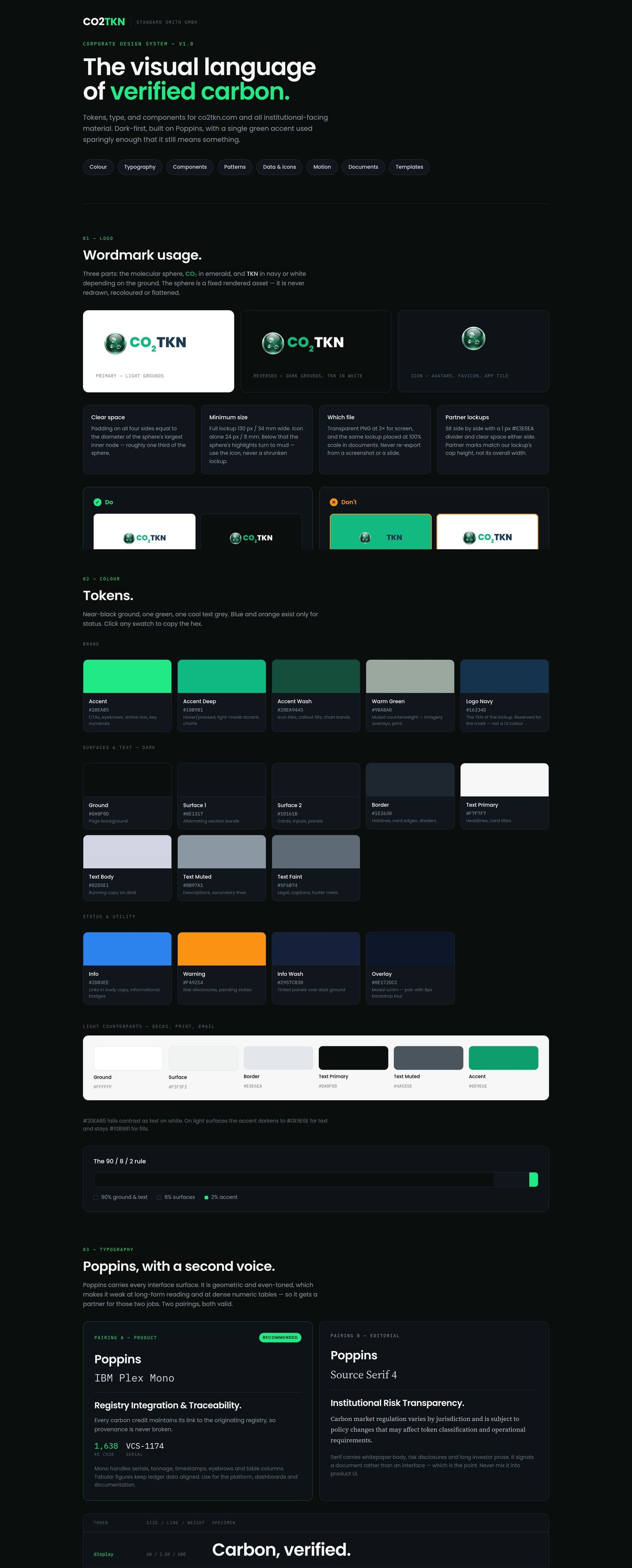
Tokens, typography, components, patterns, motion, data rules and document templates — a dark-first identity built on Poppins with a single emerald accent governed by a 90/8/2 rule.
Institutional website
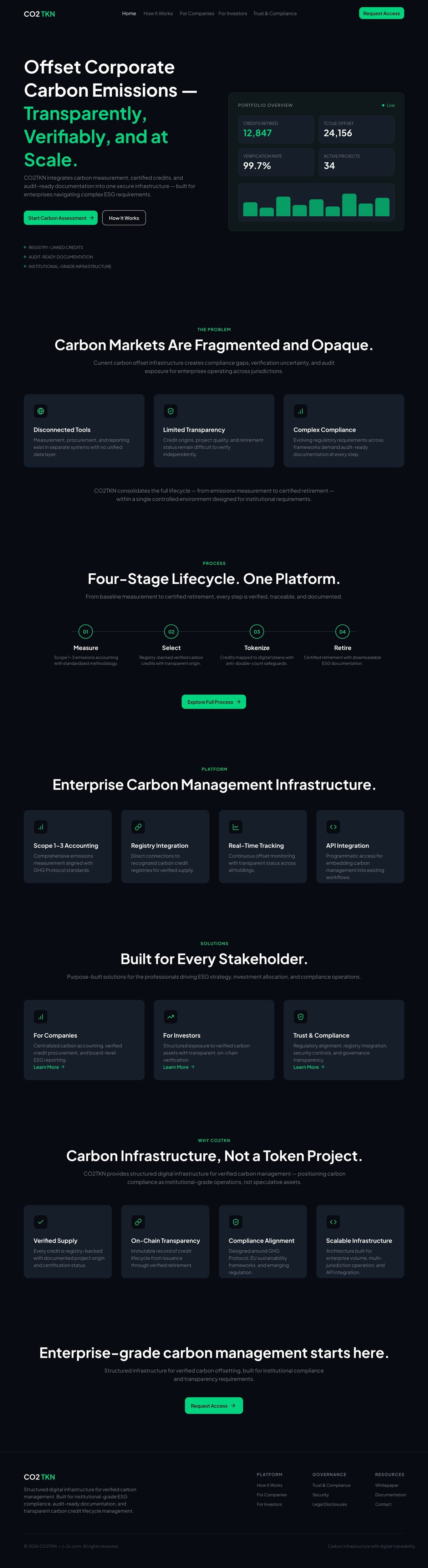
Five audience-led routes — how it works, for companies, for investors, trust & compliance, request access — assembled from a small set of repeatable blocks so a compliance page and an investor page never argue.
Multi-asset platform UI
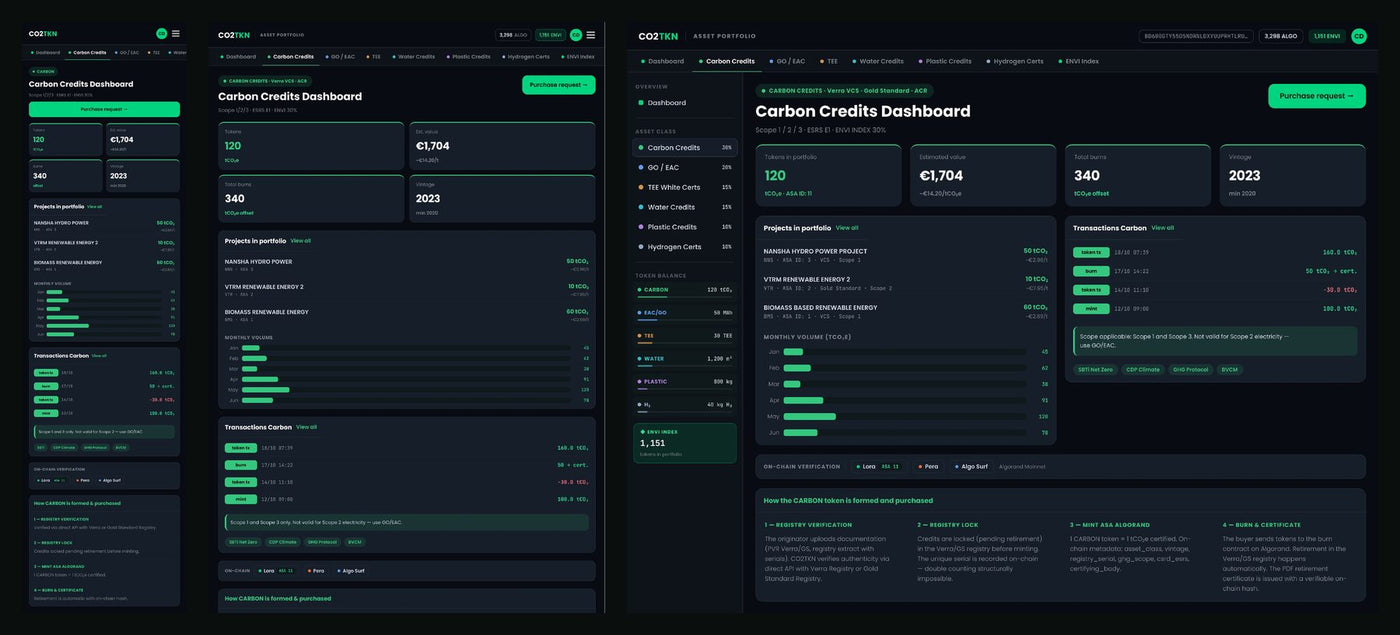
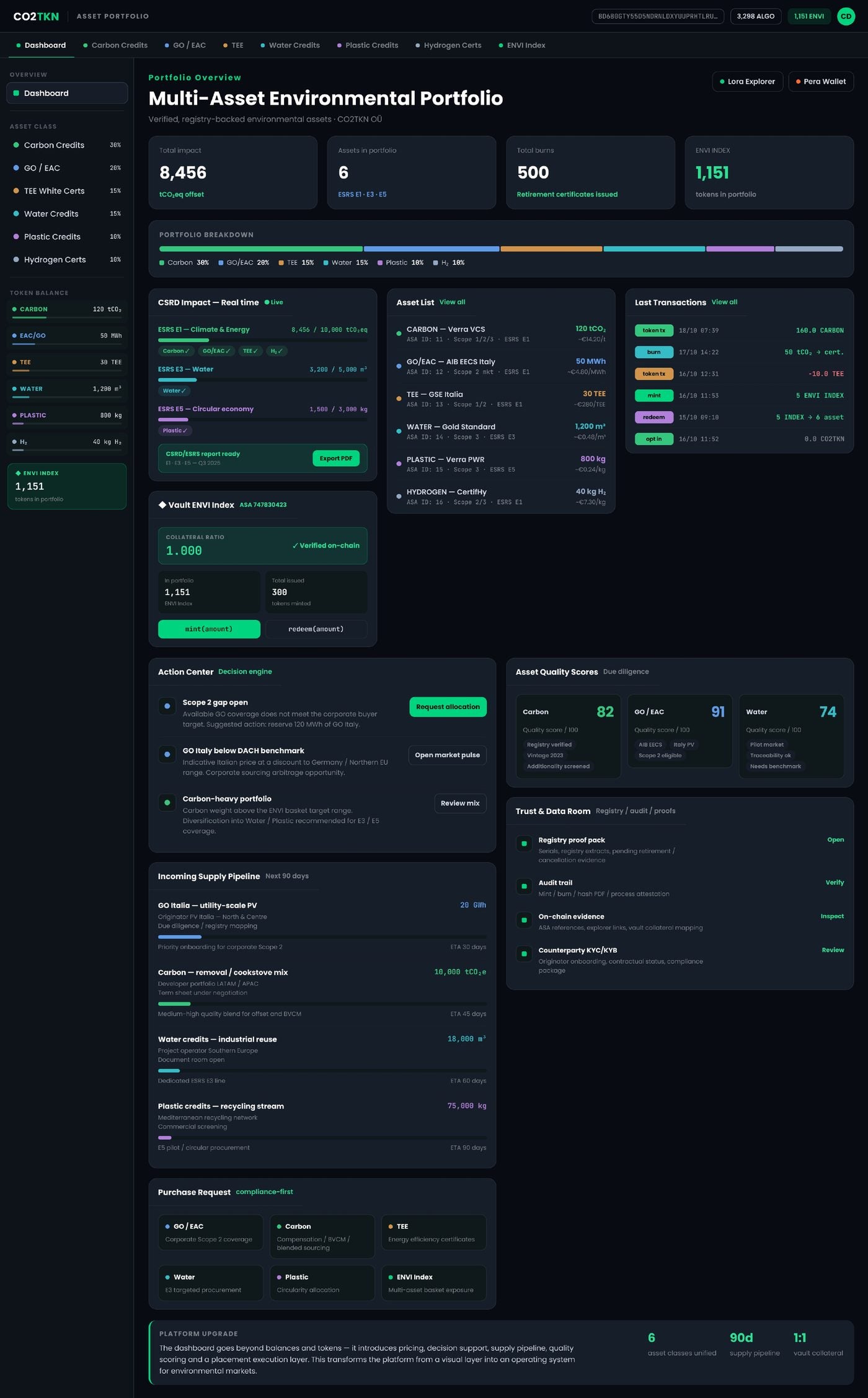
A responsive interface across seven asset classes, with CSRD/ESRS impact tracking, on-chain verification, supply pipeline, quality scoring and a compliance-first purchase request — desktop, iPad and mobile from one component set.
The challenge
What the business had to resolve.
CO2TKN sells trust in a market where trust is the product. Carbon claims attract scrutiny, the buyers are CFOs and compliance officers, and the underlying asset is ultimately a serial number in a registry. Everything the brand does has to read as auditable rather than promotional — while still explaining a genuinely complex lifecycle to people who are not carbon specialists.
- A tokenised carbon proposition that has to read as institutional infrastructure, not as a crypto project
- Three distinct audiences — corporate ESG, institutional investors, compliance — served by one platform
- Seven asset classes with different registries, scopes and units to hold inside a single interface
- Dense ledger data — serials, tonnages, vintages, hashes — needing typographic rules rather than decoration
- Regulatory and risk language that must appear verbatim, without deadening the page it sits on
- A public website and a live product drifting into two different visual languages
What n-2v changed
Identity, website, product interface and operating model, designed as one system.
-
A dark-first identity with a disciplined accent
Near-black ground, one emerald, one cool grey. The green is reserved for calls to action, active states and key numerals under a 90/8/2 split — so when something turns green on this platform, it means something.
-
Two typefaces with fixed jobs
Poppins carries every interface surface. IBM Plex Mono carries serials, tonnages, timestamps and table columns. Source Serif 4 carries whitepapers and disclosures. The division of labour is fixed, and that is what stops the system drifting.
-
Repeatable blocks instead of bespoke pages
Navigation, hero, process stepper, feature grid, disclosure panel and CTA, sequenced at a fixed rhythm — so a new audience page is an assembly job rather than a design project.
-
Data patterns treated as functional rules
Tabular figures, right-aligned ledgers, status chips, quality scores and a disclosure panel that never borrows the accent. Compliance content made legible without being made alarming.
-
One component set across desktop, iPad and mobile
The dashboard collapses from a four-up desktop grid to a two-up tablet layout to a single mobile column without losing hierarchy — same cards, same rules, same reading order.
-
GRID-OS applied to a custom-built product
The operating model N-2V runs for retained clients — priorities, roadmap, delivery, reporting — was applied to a bespoke platform build. Identity, website and product interface were sequenced as one 90-day roadmap instead of three separate procurements.
-
Custom project solutions inside a standard operating rhythm
GRID-OS assumes nothing off the shelf. Here it wrapped bespoke engineering — registry integrations, tokenisation flows, CSRD/ESRS reporting — as roadmap items with the same prioritisation, handover and reporting discipline as the website, so the custom track never became an unmanaged one.
The outcome
What changed for the business.
These outcomes are qualitative and visible in the delivered identity, website and platform interface. No traffic, conversion or trading percentages are claimed here: measurement was set up as part of the GRID-OS reporting layer and should be read against an agreed baseline once the platform is live.
- One recognisable institutional standard across the marketing site, the product interface and the document set
- Seven asset classes unified inside a single navigation and component model
- Compliance, risk and disclosure content given a fixed, honest visual treatment rather than ad-hoc styling
- Registry and on-chain evidence made legible to non-specialist decision-makers
- A responsive system that holds on desktop, iPad and mobile without a separate redesign
- A custom-built platform delivered inside a repeatable operating model rather than as a one-off project
- Reusable rules that remove subjective judgement from the next page, deck or memorandum
The delivered system
How the system works in practice.
Visual proof
One standard, two surfaces.
The public website and the live platform interface, built from the same tokens, components and data rules.
“In a market that sells verification, the interface has to look like evidence. Every rule in this system exists to make a claim checkable rather than impressive — and GRID-OS is what kept the identity, the website and a custom-built product moving to the same roadmap instead of three different ones.”
Run your custom build inside one operating model.
GRID-OS sequences strategy, identity, interface and delivery against one roadmap — including bespoke product work. A short call is enough to establish whether this way of working fits your organisation.
Book a GRID-OS Discovery Call